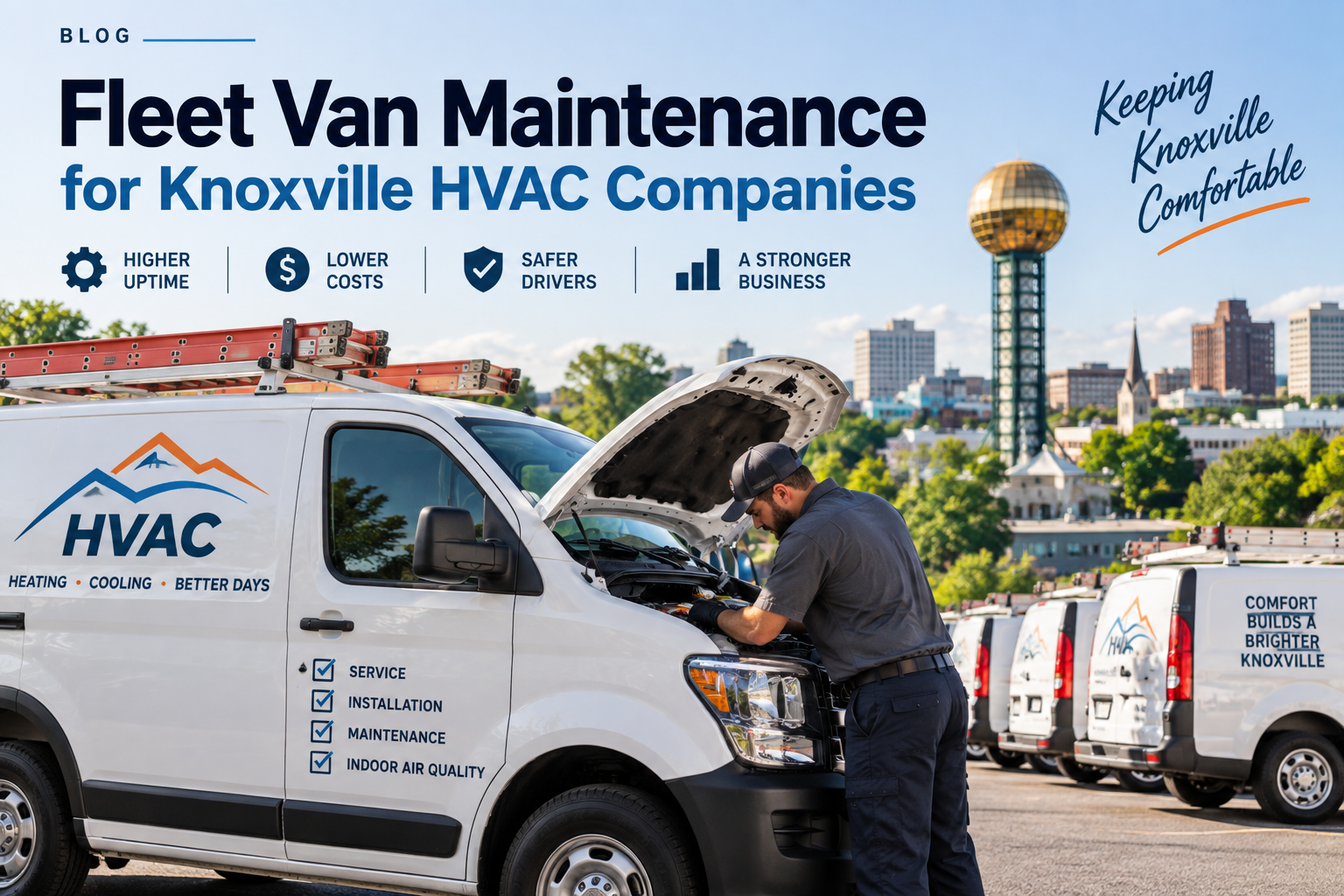
Picture a Tuesday morning in July. One of your best technicians shows up to the shop, loads his van, and turns the key. Nothing. Or worse — he makes it to the first call and the van goes down in a customer’s driveway in 95-degree heat with eight more appointments behind him.
For a Knoxville HVAC company, that scenario isn’t just an inconvenience. It’s a lost service call, a frustrated customer, an overtime scramble, and a repair bill you didn’t plan for — all before 9 a.m. And if it happens at the peak of summer, when your phones are already ringing off the hook, the timing couldn’t be worse.
Fleet maintenance for HVAC companies rarely gets the attention it deserves. Most owners are focused on technicians, training, equipment, and customer reviews. The vans get serviced when something breaks, or whenever someone gets around to scheduling it. But for a trade business that lives and dies by showing up on time, your fleet is as important as your tools — and treating it as an afterthought is one of the most expensive habits a growing HVAC company can have.
What Knoxville HVAC Companies Are Actually Running
The typical Knoxville HVAC fleet is a mix of Mercedes Sprinter vans, Ford Transits, and Ram ProMasters, with the occasional pickup truck handling larger installs or commercial jobs. These are serious working vehicles. Before a technician sits down, they’re already loaded with refrigerant, diagnostic equipment, ladders, copper fittings, and parts inventory that add hundreds of pounds to the vehicle’s base weight.
The Sprinter van has become the vehicle of choice for HVAC operations across the country, and for good reason. The high roof gives techs room to stand and organize their inventory. The payload capacity handles equipment load without complaint. The diesel engine delivers reasonable fuel economy despite what it’s carrying. But the Sprinter is also a vehicle that absolutely requires a shop that understands it — not just in a general sense, but a shop with real hands-on experience with Mercedes-Benz diesel systems, AdBlue requirements, and the electronic architecture that makes these vans different from anything in the domestic lineup. When a Sprinter goes down and the shop you called has never seen one up close, the delay compounds the damage.
The Maintenance Pressures That Are Specific to HVAC
HVAC fleet vehicles take a specific kind of punishment that general-purpose shops don’t always account for when they look at your vans. The combination of stop-and-go neighborhood routing, frequent cold engine starts throughout the day, and sustained heavy payload creates unusual wear patterns on brakes, suspension components, and drivetrain parts that most manufacturers’ maintenance intervals weren’t designed around.
In Knoxville specifically, the terrain adds to that stress in ways that are easy to underestimate. East Tennessee’s hills mean your vans are working harder on every single route than a flat-terrain fleet in Nashville or Memphis would be. Brakes wear faster on the descents. Transmissions labor on grades. Cooling systems run hotter during summer months when vans are sitting in direct sun while a tech is working inside an attic or crawlspace that may already be 130 degrees.
The seasonal nature of the work creates another pattern worth taking seriously. During peak demand — the height of summer and the coldest weeks of winter — your techs are putting maximum miles on your fleet at exactly the moment you can least afford a breakdown. The vans that need the most attention are the ones being driven the hardest, and the timing never lines up in your favor if you’re running a reactive maintenance program.
Why a Dedicated Fleet Shop Changes the Math
Most HVAC companies in Knoxville handle their vehicles the same way most people handle their personal cars — reactively. Something breaks, they call around, they bring it in, they wait. The problem is that reactive maintenance is by far the most expensive kind. A timing belt that fails on the road costs three to four times what a scheduled replacement would have. A brake job you defer until the pads are metal-on-metal costs you the rotor too. A slow coolant leak that becomes an overheated engine on the way to a commercial account costs you the head gasket and the relationship.
A dedicated fleet shop changes that equation in ways that show up directly on your bottom line.
The first is priority scheduling. When you have a fleet account relationship with a shop, your vehicles don’t wait in line behind walk-in retail customers. You call, you bring it in, you get it back. That alone changes the downtime calculation for any service company that can’t afford to have a van sitting for two days.
The second — and the one that adds up the most over time — is preventive maintenance on a real schedule. A fleet shop that knows your vehicles builds maintenance intervals into a plan, tracks them across your whole roster, and flags what’s coming before it becomes a breakdown. That is a fundamentally different service than what you get walking into a shop as a retail customer they’ve never seen before.
What to Actually Look for in a Fleet Shop
Not every shop that says it handles fleet work is set up to do it well. A few things worth asking before you commit an account: Do they have hands-on experience with Sprinter vans specifically — not “we can work on European vehicles” but documented Sprinter service history? Do they carry real diesel expertise, or is most of their experience with gas engines? Can they give you a rate card for your specific vehicles rather than quoting every job individually?
The shop you want is one that treats your vehicles as a maintenance program, not a series of disconnected repairs. That means they know each van in your fleet, they track the service history across your roster, and they’re proactive when something is approaching its service interval — not waiting for you to call when a warning light comes on.
For Knoxville HVAC companies, proximity to your routes matters too. A shop on the west side or north side of the city covers a large portion of the suburban corridors where your techs are working. Getting a van in and out without pulling a technician off the road for half a day is part of the efficiency equation, and a shop that understands that will plan accordingly.
A Practical Starting Point
If you’ve never formalized fleet maintenance, the starting point doesn’t have to be complicated. Pull the mileage on every vehicle in your roster. Note the last documented service date for each one. Ask your technicians if anything feels off — a pull to one side, a noise on cold starts, a warning light someone’s been ignoring. Then bring them in for a fleet inspection at a shop that will give you a written condition report on every vehicle.
From that baseline, a good fleet shop can build a maintenance schedule tailored to your operation — not a generic interval chart, but a real plan that accounts for how your specific vans are being used, the weight they carry, and the kind of routing they run in Knoxville.
That one conversation tends to surface three or four deferred repairs that would have become emergencies within the next 90 days. Which is usually all it takes for an HVAC owner to understand why a fleet account is worth having.
For more on fleet maintenance for Knoxville service companies, see our guides for plumbing contractors and our overview of building a preventive maintenance schedule for service van fleets.
Ready to Talk Fleet?
Knox Speed & Diesel specializes in fleet vehicle service for Knoxville service companies, with dedicated expertise in Mercedes Sprinter vans, diesel engines, and domestic work vans including the Ford Transit and Ram ProMaster. Fleet accounts include priority scheduling and preventive maintenance planning across your entire vehicle roster. See our full list of services for everything we cover.
To set up a fleet consultation or learn about fleet account pricing, Visit our fleet service page in Knoxville, contact us online, or call (865) 351-3941. We’re at 227 Sherway Rd, Knoxville, TN — Monday through Friday, 7:30 AM to 5:30 PM.